
I can’t quite put my finger on the moment I met our next protagonist, but it was around 9 years ago. Somewhere between shared neuroscience departmental years and passing conversations, she became a familiar constant: thoughtful, sharp, and always working on something that felt secretly important. Her name is Özge, but in my head (and in this piece), she’s Ozzy! Surprisingly, my favourite memory of Ozzy took place during the pandemic, when she lived just down the road from me. Walks would end beneath her apartment window, with conversations drifting from lockdown life to research to the strange collection of gnomes her downstairs neighbour kept hanging from the shutters. It was an odd, grounding ritual in a period when everything else felt uncertain.
This piece comes out just in time for Ozzy’s birthday, but it’s also a celebration of something far bigger: the journey of her project, Anesthe-Mate. Born from her PhD thesis and now evolving into a full-fledged startup, Anesthe-Mate is the result of years of research, collaboration across multiple departments and teams, and a level of ambition that is as complex as it is impressive. That journey was recently recognised with an Innosuisse grant of over CHF 1 million, an extraordinarily competitive achievement.
But how does one build a startup from an academic idea? Where does it begin, and what does the path actually look like? These are the questions Ozzy answered during a long, comfortable conversation on the sofa of the Neurolounge, perched on the seventh floor of the Fundamental Neuroscience Department at the University of Geneva, a fitting place to talk about how an academic idea escapes the lab.
Setting the rhythm
Ozzy’s work sits at the intersection of engineering and neuroscience, a place she seems comfortable occupying. She started out in industrial engineering, where systems, efficiency, and the business side of building things mattered as much as the technical details. She particularly enjoyed economic engineering, thinking not just about what to build, but how to make things work better, scale sensibly, and fit into modern production.
The pull toward entrepreneurship showed up early. Back in 2012, while finishing university, she was already co-founding a startup with friends she had written her bachelor’s thesis with: a home automation system built well before “smart homes” became mainstream. It wasn’t a detour so much as a parallel track with research on one side, and building on the other. That way of thinking still shapes how Ozzy talks about startups today. She emphasises that the focus is rarely on bold leaps or overnight success, but on balance—effort versus output, learning when and where to push, and when to hold back. It’s a practical mindset, and one that helps explain why only a small fraction of startups survive.
After her studies in Engineering, she moved into neuroscience, driven partly by the realisation that she no longer wanted to work with ‘dead’ things, but with humans instead. She eventually moved to Geneva to pursue her PhD in Neuroscience, and so marked the beginning of Anesthe-Mate.
Drifting off
Anesthe-Mate didn’t start as a product, or even as a plan. It began as a side observation in the lab before Ozzy’s PhD, while she was working with two-photon imaging in mice (a high-resolution technique that allows researchers to observe neuronal activity deep in the brain in real time). The experimental setup included cameras tracking whisker movement, and it was there that something unexpected appeared. Sometimes, right in the middle of a neuroimaging session, the mice fell asleep.
Changes in their pupils made it clear what was happening: they constricted, characteristic sleep patterns emerged, and periods of REM (rapid eye-movement) could be identified. What was meant to be a short, six-month detour—just tracking and quantifying the observed phenomenon— expanded into two full years of work.
A natural next question followed: could the same approach work in humans? Early experiments were improvised, with taped open eyes and VR goggles adapted with embedded cameras to track pupil behaviour during sleep. The setup did exactly what it was meant to do: pupil measurements reliably reflected whether someone was asleep, how deeply, and in which state.

Ozzy finished her PhD during COVID, at a moment when next steps felt unusually open-ended. Rather than moving straight on, she took time to think about what this method could become outside the lab. Could it work as a device? Could it be useful beyond research? A bridge fund between the SNSF and Innosuisse helped formalise those questions, requiring a small business plan, a pitch deck, and a shift from results to potential use.
From there, Anesthe-Mate began to take shape: algorithms were refined, and hardware followed. Collaborations expanded, including work with another lab, where images were presented to sleeping participants. Conversations with clinicians, particularly in anaesthesia and intensive care highlighted a persistent limitation: patients may be unconscious during surgery, but what is happening physiologically remains difficult to track in real time. Pupil behaviour offered a way in. During sleep, pupil dynamics reflect depth and state, indicating arousal, stability, and transitions across different stages.
From lab to bedside
What came next pushed the work into an entirely different environment. The goggles were tested on patients under general anaesthesia, where pupil dynamics could indicate multiple aspects of internal state, including nociception (how the body responds to pain). Doing this meant stepping into a clinical world with its own rules. Ethical approvals were required. Formal protocols had to be developed in collaboration with the HUG (Hôpitaux Universitaires de Genève: the biggest university hospital in Switzerland). Nothing moved without alignment.
The scope expanded quickly, and Ozzy began working with multiple departments while reaching out to hospitals across Europe to test the robustness of the idea. These conversations sharpened the clinical challenge. During surgery, patients are often deeply anesthetised and pharmacologically immobilised, meaning they cannot move even if their internal state changes. Because dosing is based on broad parameters (like age, height and weight). and existing proxies rely on indirect signals like heart rate, finding a more reliable window into pain and arousal became central.
So far, recordings have been completed on 24 patients. More were contacted (over 150), but clinical reality intervened. Some patients were excluded after ophthalmological screening, and some simply due to anxiety. Others couldn’t be followed through due to incompatible equipment in operating rooms, changes in patient positioning, or last-minute shifts in surgery timing. It’s a far cry from the controlled conditions of fundamental neuroscience where every variable is controlled, and relying on so many moving parts made progress harder to predict.
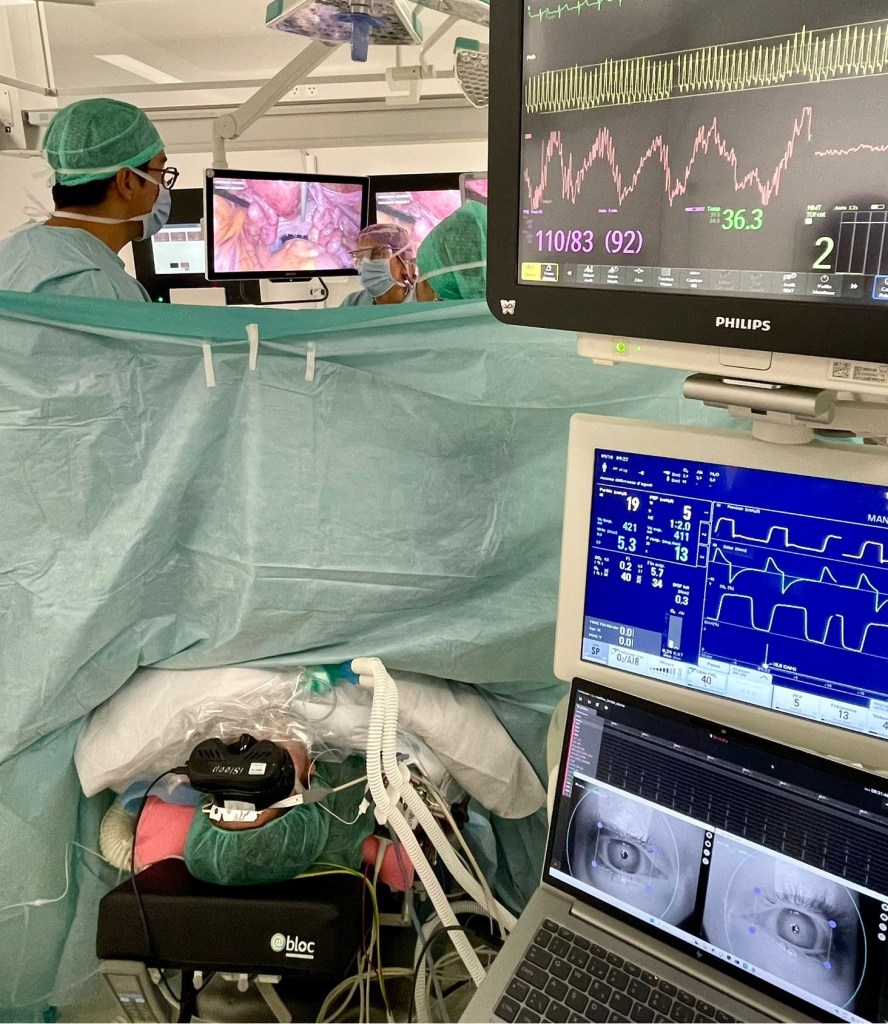
Up to now, the work has been strictly observational. Even so, patterns are emerging. In roughly 30% of patients, sympathetic responses (the body’s automatic stress reactions) to pain were not sufficiently dampened during surgery, as reflected in eye movements and pupil dilations. Autonomic signals typically monitored in clinical practice such as changes in heart rate, often remain stable or shift at much slower timescales, meaning that some painful events may go unnoticed without pupil tracking. The next step is to strengthen pre- and post-surgical recordings, building a more complete picture around the moments that matter most.
Supporting this phase meant assembling funding from several sources, a process Ozzy led herself, writing applications and coordinating proposals across institutions. This includes a large SNSF grant awarded to her partner lab, as well as support from UNITECH, FONGIT and Fondation Bertarelli. The funding supports salaries, equipment, and coordination across teams. With the recent addition of over CHF 1 million from the Innosuisse grant, those resources are now structured across the different groups involved to support hardware and software development and clinical testing.
The sleepless nights
Not everything about building Anesthe-Mate could be shared as it happened. Filing patents, planned through 2025 in several countries meant that parts of the work had to stay under wraps longer than is typical in academia, since publishing too early wasn’t an option. But the slower pace wasn’t only about intellectual property. This kind of project was new territory for everyone involved, and without an established blueprint in the lab or department, the team chose to move cautiously. There was also a deliberate decision to publish the biological findings alongside the method itself, which meant collecting years of data beyond the first working version of the device. Together, those choices shaped how the project moved forward, and shifted the usual rhythms of academic output.
Publication timelines were thus shifted, and for a while the work remained largely invisible. A major paper is now close (and already in pre-print): with 27 authors spanning hospital staff, and surgical departments (all the way from ophthalmology to sleep medicine). And getting there required coordination at a scale far removed from a single lab or discipline.
There’s a personal cost too. Keeping a project quiet, carrying responsibility across teams, and working at the edge of several systems can be isolating. Ozzy is open about the fact that this kind of work can be lonely. She’s also candid about how her ADHD shapes the process: intense focus on what captures her interest, paired with ongoing struggles around time management. The project doesn’t suffer, but other parts of life sometimes do. Turning fundamental research into something clinically useful and eventually market-ready is a difficult leap. Anesthe-Mat sits right in that gap, and the difficulty of crossing it is part of the story!
Staying awake
Ozzy talks about Anesthe-Mate a bit like a child: something she cares deeply about, but knows she can’t cling to too tightly. What keeps her moving forward is less stubborn attachment than momentum: seeing that other people find value in it. More hospitals are now involved, and across them the same limitation keeps coming up: despite all the monitoring in place, there’s still no reliable way to measure pain during surgery. Knowing that this gap is widely recognised, and that the questions matter beyond her own work, is what sustains the project.
She’s also quick to point out that none of this would have happened without collaborators, especially the ophthalmology department, whose involvement made the work possible at all. Over the past three to four years, she’s also been supported by a coach, Marco (an MD with an MBA and a background in pharma) who specialises in guiding medtech and biotech startups in Switzerland, helping her navigate decisions far outside academic training. Alongside that, there’s continuity in people like Gregorio, a close friend and former lab colleague from her PhD years (and a list of others; but I won’t add them all here to avoid this turning into an Oscar acceptance speech). What sustains the project isn’t a single source of motivation, but a network of trust, feedback, and shared investment. Outside the work, time in the mountains skiing, climbing, and walking, as well as time spent with her family, help her switch off and come back to it.
Looking ahead, the focus for Anesthe-Mate is on turning the work into something clinicians can truly use: developing an advanced prototype with new engineering and data science partners, building a clinical database with the HUG and other hospitals, and validating its clinical utility. After that hopefully comes regulatory approval and, eventually, bringing the device to market over the next 2-3 years.
From a clinical perspective, the priority is not just whether nociception can be measured with eye tracking, but whether a robust device can meaningfully support decisions in the operating room, helping guide anaesthetic and analgesic dosing for unconscious patients, and improving care in practice.
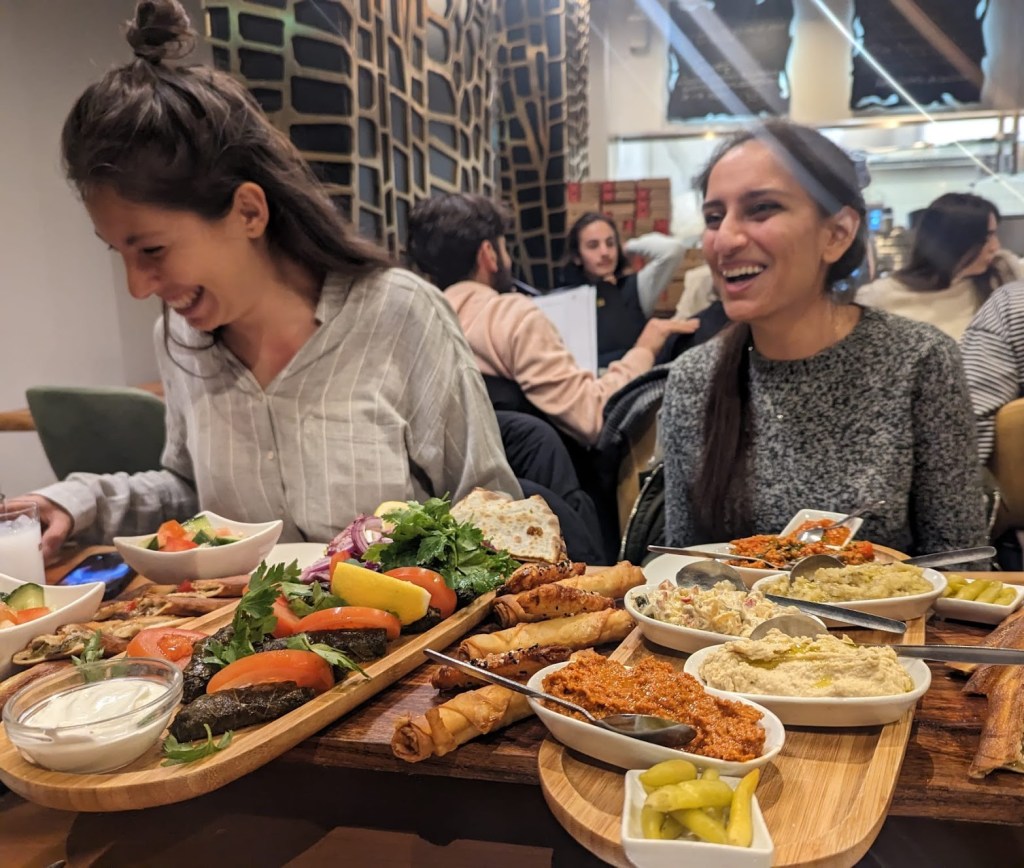
It’s been fascinating to see Ozzy take this from a PhD project to a real, functioning clinical tool, much of it pieced together for me over long meals, good food, and unhurried conversations. After years of thought, persistence, and care, the success feels genuinely well-deserved! I can’t wait to see where the project goes next, and what it might make possible once pain no longer has to remain invisible during surgery.
 Talks in Tan-dem
Leave a comment