
I am unsure about how to begin this piece and that would also explain the length of time between this and my previous post. In addition to the fact that I recently started a new job and said goodbye to my lab, which I was at for almost 9 years. 9 years – even writing that out sounds unbelievable. Perhaps if I start from the beginning it will all make sense.
Back in 2016, a 21 year old me moved to a brand new city where I knew no one and where they spoke a brand new language to me. I had moved to Geneva to join the lab of Professor Anthony Holtmaat as a masters student. I joined his lab because I was interested in pursuing research and science and furthering what we know about the brain. Little did I know that I was about to embark on not just the start of my career, but a wonderful journey of knowledge acquisition and personal growth. And none of it would have been possible without Professor Anthony Holtmaat himself – the subject of this potentially eye-welling, tear-jerking profile (particularly if you are an animal lover like we are).
The first few times I met Anthony, I used to call him Professor Holtmaat. He was my boss and I wanted to make sure he knew I respected him (I quickly realised he did not really care much for hierarchy and stopped). A year later, Anthony offered me a PhD position for the end of my masters, and I happily accepted. I loved my projects, my co-workers, and the freedom he gave us to bring forth ideas and to work on what we wanted to work on – within reason of course. And so I continued along my research journey, integrating further and further into the lab, organising all the social events and annoying as many people as I could with my friendship. Lab members came and left, the pandemic started, and life started to feel more and more uncertain. During this time I turned to the most humble and experienced scientist I knew – Anthony. So began our ‘career talk’ meetings, but also our talks about life, our hobbies, and what we wanted from the future. I discovered this very special quality that he had – that I now realise is a wonderful quality in a manager – where he would find topics to talk about that interested each individual. He would start our meetings with a little conversation about some cute animals he’d seen, and it would make me feel comfortable about the impending complicated data I had to show him, and make me feel seen all at the same time. It was through these pre-meeting chats that I realised that not only was he one of the smartest people I’d ever met, but also a wildly (pun intended) talented nature photographer.
The original lens
How did a Professor of Neuroscience at the Faculty of Medicine at a world-renowned university by work-day, become an avid nature photographer by holiday? That is exactly where we started.
Anthony’s first camera originally belonged to his father. He got his hands on it back in high school, and is still in the family to this day. The real spark, however, came from an unlikely place: his chemistry teacher. This teacher had installed a darkroom at the school and took the time to teach his students not just how to take photographs, but how to develop them, too. Black and white prints slowly emerged in trays of chemicals under red light – science and art fusing in a way that mirrored Anthony’s future path as a microscopist more than he probably realised at the time. Anthony learned by doing. He experimented with contrast, exposure, and aperture size, figuring out the technical bits through trial and error.
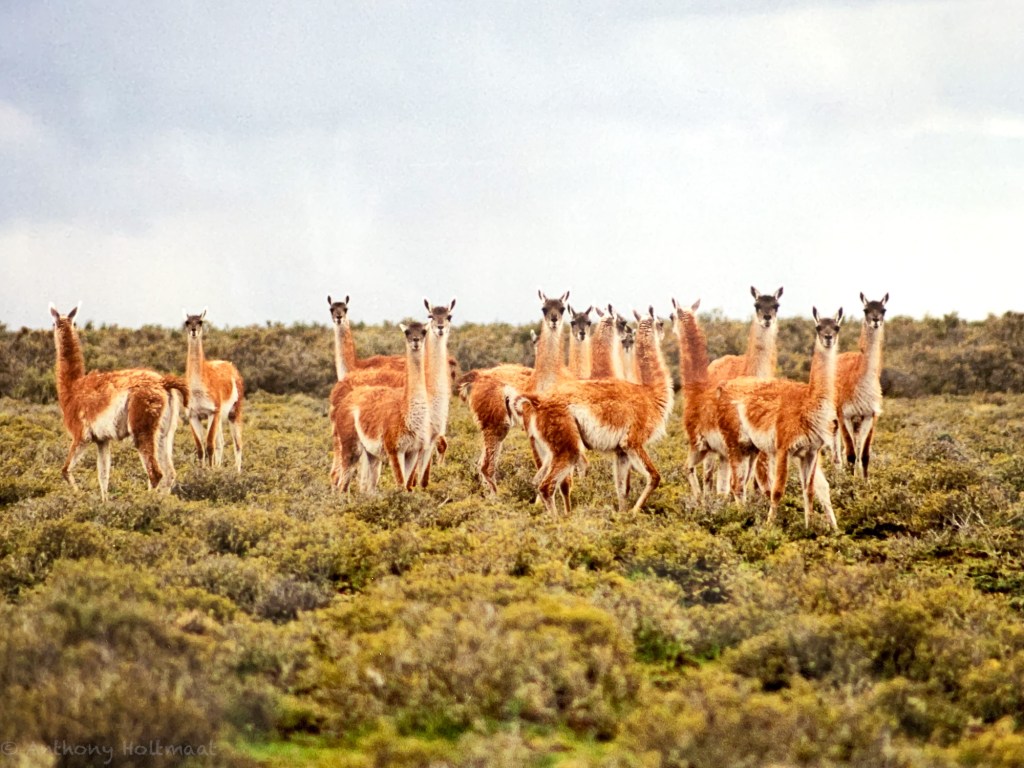
Eventually, he saved up enough money to buy his own camera, though developing photos at home was not exactly practical (darkrooms don’t tend to come with the house). Still, he brought his camera along on trips, like one he recalls fondly to South America, capturing the world as he experienced it. Photography back then was a more deliberate act. Film rolls meant making choices, because you couldn’t snap hundreds of photos and delete the ones that didn’t make the cut like we do today. Each frame had to be worth it, making the final shots a little more magical.
But as university life picked up pace, photography quietly receded. Anthony had less time, and other interests like sports were taking up his free time. Digital cameras were just emerging, though the technology wasn’t quite there yet – with mirror reflex models being expensive, and their resolution uninspiring. On top of all that, he had not yet figured out what kind of photographer he wanted to be. Still, the seed had been planted, and though it lay dormant for a while, it would not stay buried forever.
Finding his focus again
Years later, once Anthony had moved to Geneva and begun the daunting task of setting up his own lab, and laying the first bricks of what would become a thriving research group – photography quietly found its way back into his life. He made a conscious effort to reunite with this passion, and invested in a proper kit with a good camera and great lenses.
In many ways, photography became a counterbalance to the intense, intellectual demands of academic life. It was a hobby that required patience, discipline, and immersion in nature. He would get up early, often before dawn, and go hiking in the surrounding hills and forests, quietly searching for animals. It was both a meditative practice and a technical challenge. To get a good shot, you can’t just stumble upon wildlife, you have to become part of the environment. Anthony learned to stay still for long stretches of time, to move with intention and to pay attention to wind direction (approaching with the wind at your back is a rookie mistake because animals will catch your scent in seconds). He studied the patterns: such as the deer skirting the edges of woods, darting across fields where they felt exposed, entering from angles where they felt least threatened. You cannot lure them in – they had to decide to come into the frame on their own terms.
Even the camera itself can work against you. Animals find its size, shape, and the way it protrudes from the face rather unfamiliar and possibly threatening. So not only do you have to earn the animals’ trust, you also have to make your tools as inconspicuous as possible. Thus, with nature photography, you kind of take what you get. You cannot direct a deer to turn their head just so, or ask a fox to wait for better lighting. The animals decide if, and how they show up. But that’s exactly where the creativity begins.

For Anthony, creativity isn’t about staging or control, but about noticing. It’s in choosing the right angle, picking a good spot, and understanding how light transforms a scene. He talks about the magic of early mornings – the golden hour – when the sun hangs low and bathes everything in a warm, gentle glow. That’s when the forest feels most alive, and when his photographs take on their most cinematic quality. Although he has already developed a remarkable eye, Anthony sees this creative element as something he would like to explore more deeply, and when he retires, he hopes to invest more time in it. He would like to take on projects, push his creative boundaries a little further, and maybe, he added, even use his photography to support his lovely wife with one of her many good causes.
Unforgettable frames
When asked if there were any moments that stayed with him throughout his life – those rare, almost spiritual encounters that keep that flame going – Anthony did not hesitate.
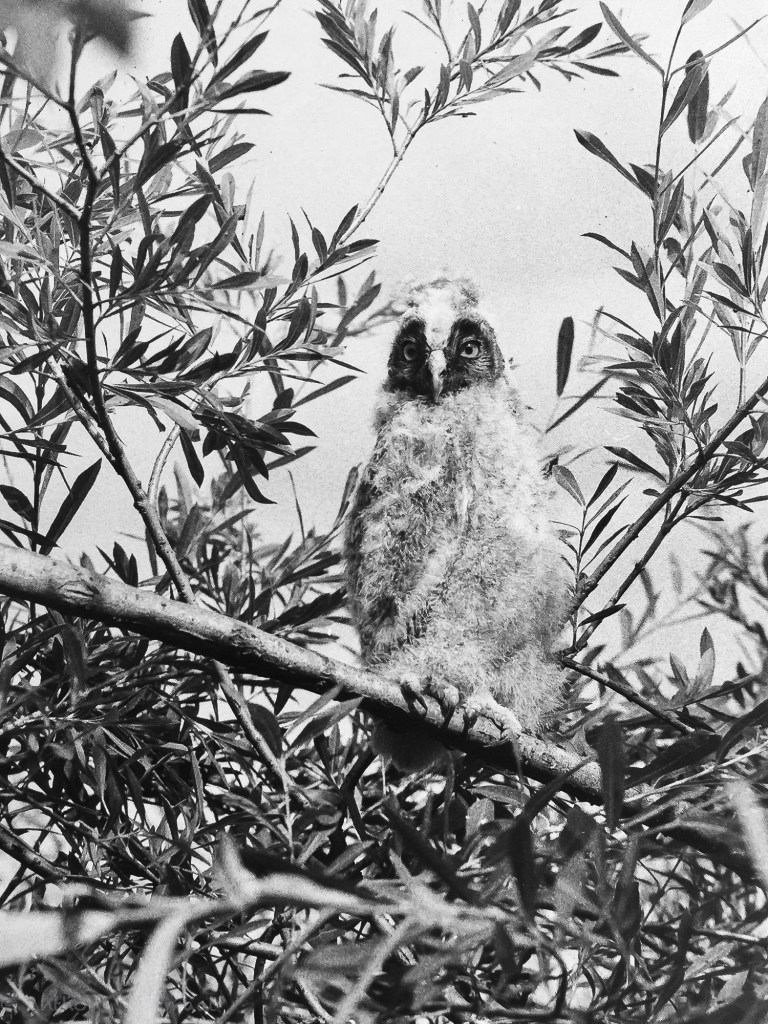
The first one takes us back to where it all began. He was 13, out with his father’s old camera, when he spotted a young owl. Not a common sight by any means, and certainly not one a beginner would expect to capture. He was afraid they would fly off, startled by the slightest movement, and so he started from far away, lifted the camera, and took a picture. Then, cautiously, he stepped forward. Two steps. Click. Two more steps. Click. All the while acutely aware that film was finite, and every shot a commitment. Slowly, patiently, he closed the distance. Finally, he was close enough for a portrait, and the owl, remarkably, stayed. It was the first time Anthony realised what it meant to earn a moment like that – and the image has stayed in his mind’s eye ever since (and now mine too, because I had goosebumps when he told me this story).
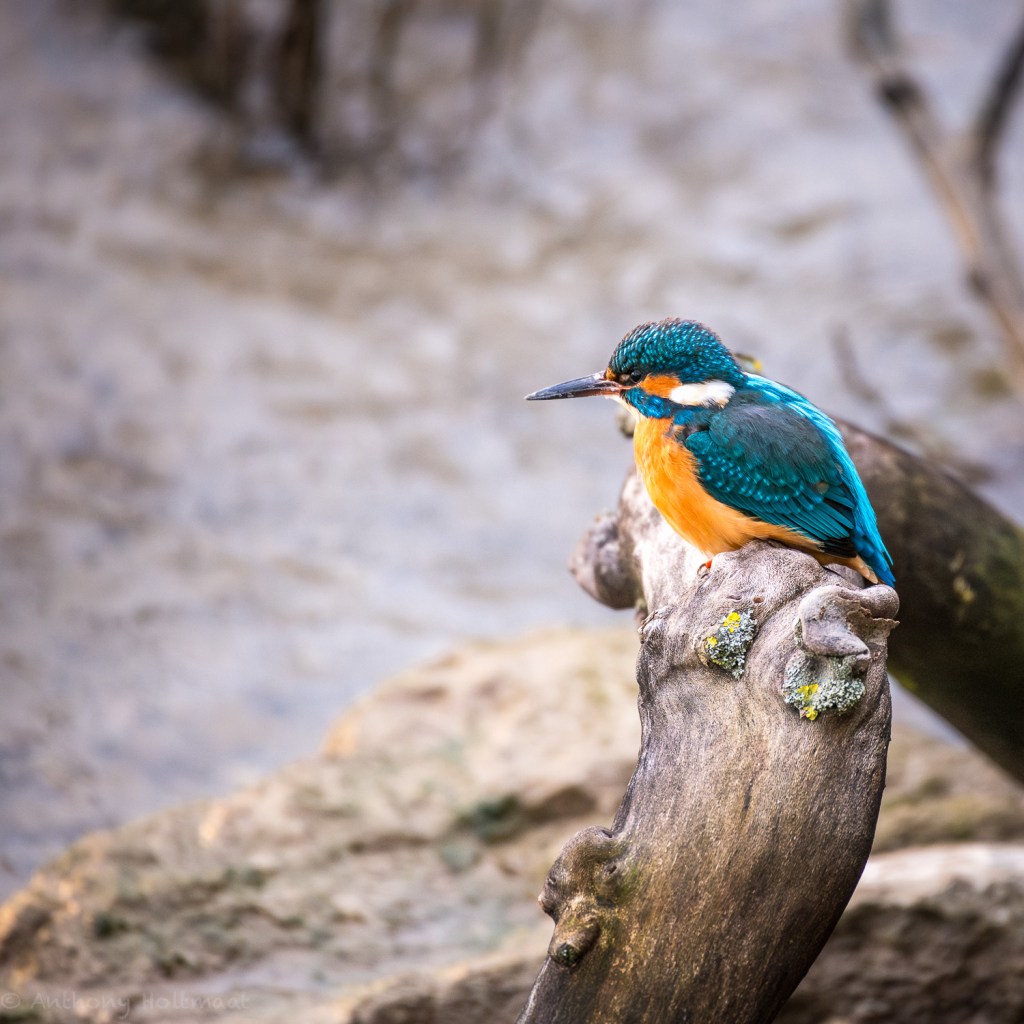
The second moment came decades later, just a short walk from home. He was strolling by the lake Leman at Parc Barton in Geneva with his wife when he caught a flash of blue from the corner of his eye. He thought to himself – ‘it can’t be a kingfisher, can it?’. But it was. The bird darted away and, to Anthony’s horror, he did not have his camera with him. Something told him however that this bird – this brilliant, elusive streak of colour – would return, as he hypothesized that this was his/her regular fishing spot. And so he went back the next morning, and the morning after that, and the one after that. Always early, and often in the freezing cold. Waiting.
Eventually, his patience paid off. The kingfisher came back and Anthony was ready this time. These are the moments that make it all worth it – not just for the photo, but for everything it represents: time, patience, awareness, and the quiet thrill of being in exactly the right place at the right time.
No pain, no gain?
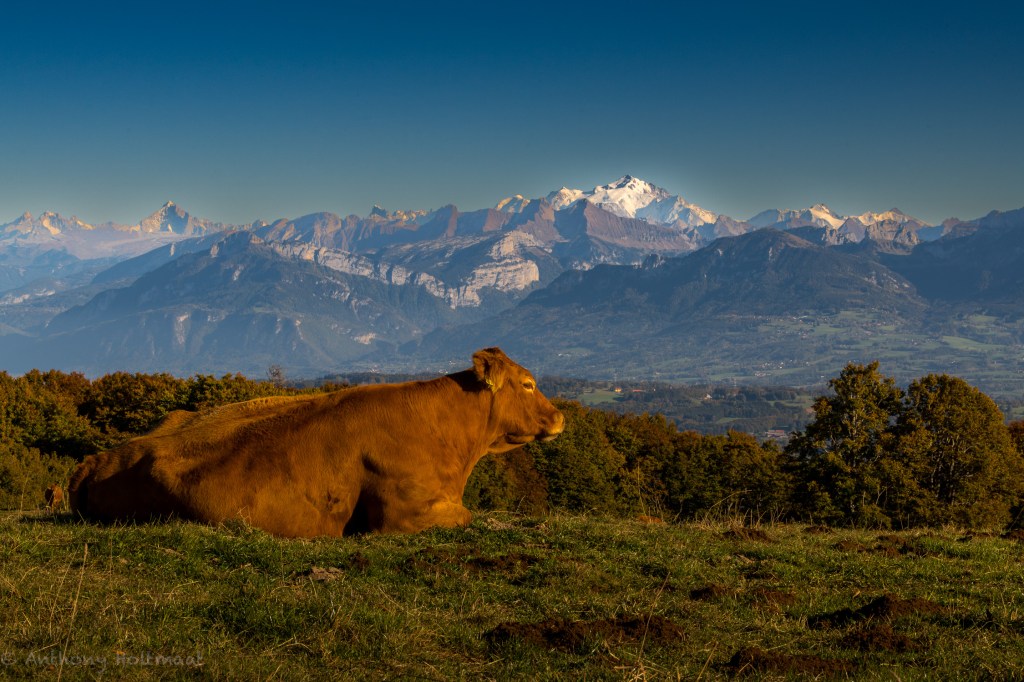
One such ‘right place at the right time’ moment came when Anthony spotted the perfect shot: a cow lounging peacefully in the grass, with the Mont Blanc rising majestically in the background. He wanted to use a technique called hyperfocus, which allows both foreground and background to stay in focus, something that I learnt is not automatic with a DSLR camera. A smaller aperture helps, but you also have to be mindful of every tiny thing in the frame. Even a single blade of grass in front of the lens can ruin the shot. So to get the composition just right, he lay down in the grass, positioning the cow in the foreground and the mountain in the distance. There he was, carefully pulling out stray blades of grass that could interfere with the image, when he felt a sharp prick. He didn’t think much of it, but a couple of centimetres of splinter had snugly lodged itself under his skin. He could feel the foreign body still in his thumb, and 3-4 days later, his thumb began to pulsate, leading to a sure trip to the emergency room. I vividly remember seeing him in the lab with his thumb the size of a cricket ball, and a whole lot of pain that came with it. All for a cow and a mountain.
Depth of field
For Anthony, photography is far more than a technical exercise – it’s a deep, emotional connection to the natural world, offering a sense of closeness. He says that having a subject in mind changes how he sees things. He notices colours, behaviours, subtle details he would have otherwise missed. He finds himself thinking about evolution: why animals behave the way they do, how they adapt, how they survive. With photography, he isn’t chasing the moment, he’s waiting for it. It’s meditative, and sometimes, while waiting in the grass for an insect to settle, his mind will wander to the big questions, the ones science often circles around but rarely answers – like, what is consciousness?
There’s joy in the detail. With insect photography, he has discovered a miniature universe hidden in plain sight. Sit still long enough, and a whole world emerges consisting of tiny creatures in brilliant colours with delicate textures, even bristles on their legs that you’d never notice without the help of a high-resolution camera. As a scientist, the parallels are impossible to ignore: observation, patience, trial and error. But unlike research, where answers take years, sometimes photography gives you a moment of pure, instant reward. Anthony is a perfectionist, always critical of his own work, but I remind him that sometimes, the real gift is in the encounter itself. In sharing that fleeting, serendipitous moment with others, even if the photo isn’t perfect, the connection is uniquely special. I myself have had tears in my eyes on multiple occasions where he has shown me his photos.
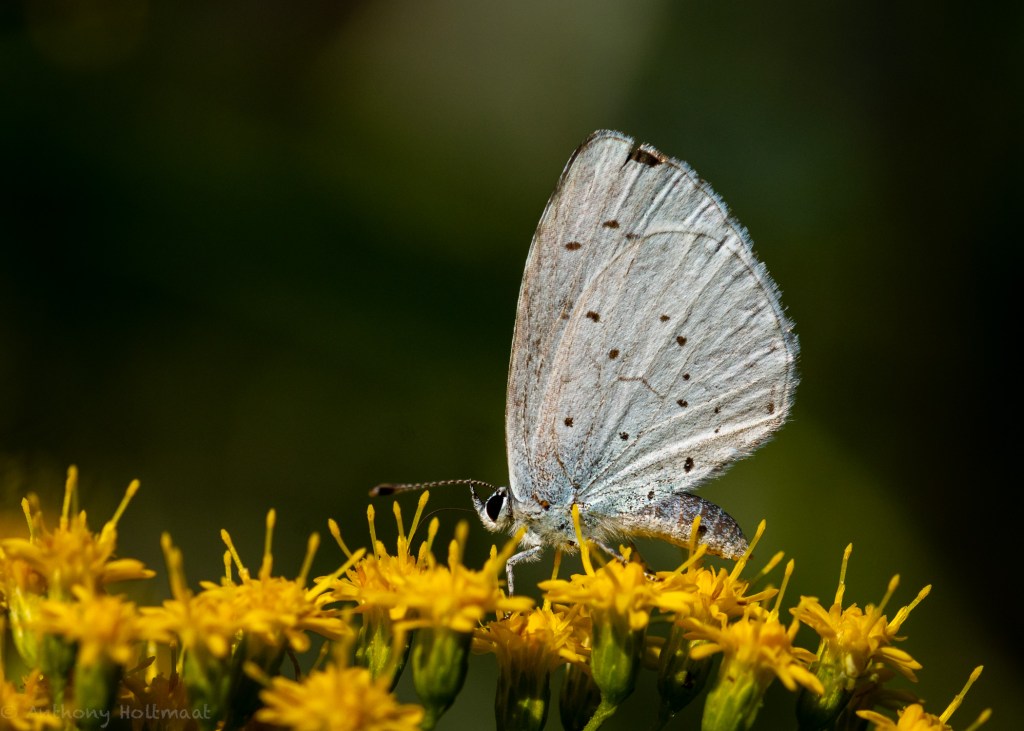
(bokeh: the aesthetic quality of the out-of-focus or blurry parts of an image)

Just as it was difficult to begin this profile, I am also finding it equally as hard to wrap it up. You see, my interview with Anthony was also our last one-on-one meeting with me as a part of his lab. I recently got an exciting new job, which would not have been possible without his mentorship and help. We finished up our long talk with one last question, where I asked him about his dream project. You will just have to trust me when I say that it will be beautiful when it comes to fruition, because I did promise to keep it a secret. Maybe I’ll leave you with this little hint – I can’t wait to see his world through different lenses!
 Talks in Tan-dem
Leave a reply to Tanika Bawa Cancel reply