
The year was 2008 and I had just moved to Zürich with my family, having also recently become a teenager. After a month in a temporary flat, we found a charming apartment in the village of Herrliberg, situated on the Gold Coast of Lake Zürich. Contrary to all the negative stereotypes about Swiss neighbours being cold and uncaring, Bettina and her sister Daria, who lived right opposite us with their parents, were incredibly welcoming. Over evenings spent “singing” with SingStar (shoutout to their patient mother) and chit-chatting, we came to admire Bettina’s room décor, which consisted of many fun knick-knacks and, of course, plenty of Michael Jackson memorabilia.
And so, while taking this trip down memory lane, I have introduced our next subject to you: Bettina. With her comes a controversial topic; perhaps my most controversial thus far. But it is one that makes you think about subjectivity and objectivity, and whether we are even aware of when we switch between the two. Are we truly capable of seeing the forest for the trees when it comes to people we admire?
Bettina is the biggest Michael Jackson fan, in life and in death, that I have ever met. Upon his passing in 2009, she bought every magazine and newspaper she could find that covered his life (much to her sister’s dismay). She has seen countless Michael Jackson tribute acts and, most recently, went to see a Jackson 5 concert in Luzern in March, which she thoroughly enjoyed. With renewed public attention around Michael Jackson following the recent release of a new biographical film and Netflix documentary, her story feels, in some ways, timely again.
Perhaps fittingly, Bettina is not only a passionate Michael Jackson fan but also a journalist by profession. Her instinct to question, analyse, and look at a story from different perspectives has always been part of who she is. Which is what makes her relationship with such a polarising figure all the more interesting. The cherry on top of it all is that she has even written a book about him in German titled ‘Unverstanden und missverstanden’ (‘Misunderstood and Misinterpreted’). Let’s dive into this story which in some ways is a simple story about a fan, but in other ways a philosophical journey of fandom itself.
The beginning of a lifelong fascination
Like many lifelong fandoms, Bettina’s began with a single song. In 1995, when Bettina was only 8 years old, Michael Jackson appeared on the German television show ‘Wetten, dass..?’ to perform ‘Earth Song’. It was an unusual performance: Jackson stood amid wind machines and sang dramatically, arms outstretched as though trying to summon the forces of nature. Critics at the time mocked the imagery, with some accusing him of wanting to portray himself as a Jesus-like figure. Bettina, however, was too young to care about any of that. She just remembers being captivated.
The fascination only grew. Her mother had read in a celebrity magazine that Michael Jackson was someone special, and Bettina remembers eavesdropping on her father playing the ‘Earth Song’ CD single in the living room. By the time she was 10 years old in 1997, it was already on regular rotation. As she entered her teenage years, a new world opened up: the internet. At 14, she could finally download his music and explore his catalogue for herself.
What particularly fascinated her were not just the songs but the videos. Today music videos are an expected part of an album release, but in the 1990s Michael Jackson’s were events in their own right. Watching clips for ‘Thriller’ or ‘Black or White’ was like watching a short film. For a young fan, there was always something new to discover.
Then came ‘Invincible’ in 2001. No one knew it at the time, but this would ultimately be Michael Jackson’s final studio album. Looking back, she is glad that she was there to experience its release. Two songs in particular stood out to her: ‘Speechless’ and ‘Privacy’, tracks she still counts among her favourites today.
The weight of a public image
Of course, being a Michael Jackson fan also meant confronting the other side of his legacy: the controversies. It is impossible to talk about Jackson without acknowledging the allegations, the headlines, and the image that the media constructed around him. This is not a story with simple answers, and it is not my place to provide them. Rather, it is the story of how Bettina experienced these events and how they shaped her relationship with someone she admired.
The way celebrities are portrayed in the media has always been complicated. Tabloid journalism, particularly in the United States and the United Kingdom, has often been criticised for relying on sensational headlines and emotionally charged narratives. Over time, public conversations have shifted, with more awareness around language, representation, and the harm that can come from reducing a person to a single story.
For Bettina, one of the first major controversies surrounding Michael Jackson came in 1993, when he faced allegations of child sexual abuse involving Jordan Chandler. The case attracted enormous media attention. Jackson denied wrongdoing and later reached a civil settlement with the Chandler family, a decision that many interpreted differently: some saw it as suspicious, while others viewed it as an attempt to end a damaging public ordeal.
Around the same period, Jackson’s changing appearance became another source of public fascination. His skin becoming lighter was often portrayed by the media as a deliberate attempt to appear white, but Jackson had publicly spoken about having vitiligo, a condition that causes loss of skin pigmentation. The conversation around his appearance became another example of how quickly speculation could become a dominant narrative.
Then, in 2003, another set of allegations emerged. Journalist Martin Bashir (the very same one that duped our beloved Princess Di) interviewed Jackson at his Neverland Ranch for the documentary ‘Living with Michael Jackson’. Bettina remembers watching the interview unfold and feeling deeply unsettled by the way she perceived Jackson’s openness being used against him. When the allegations became public, she found herself sitting in front of the television hoping he was innocent. For Bettina, the sadness was not only about the accusations themselves but about seeing someone she admired become defined almost entirely by negative headlines. She remembers how common the nickname “Wacko Jacko” became in the media, and how uncomfortable she felt with the way a person’s entire identity could be reduced to a label.
At the same time, she wasn’t a fan who refused to question anything. This tension actually became the foundation of her high school diploma thesis in 2003, titled ‘Michael Jackson: A Victim of the Mass Media.’ It was her way of examining the situation more deeply rather than accepting either extreme. She watched interviews, analysed videos, and deliberately tried to play devil’s advocate. Not trying to prove she was right, but because she wanted to understand the bigger picture. For Bettina, her fascination was primarily about the music, the artistry, and the question of how we decide what we believe about public figures.
The tour that never was
For years, Bettina had dreamed of seeing Michael Jackson perform live. So when he announced his ‘This Is It’ concerts in 2009, her first reaction was excitement. After years of controversy and absence from the stage, the possibility of seeing him perform again felt like a moment in history.
But when Jackson announced the concerts in 2007 and 2008, something about it did not feel right to her. She remembers watching the announcement and noticing that he did not seem like the energetic performer she had grown up watching. Instead, he looked exhausted and fragile. Something about his appearance gave her a bad feeling, and in the end, she never bought a ticket – talk about gut instinct.
Jackson was preparing intensively for the concerts, which were scheduled to begin at the O2 Arena in London in July 2009. Bettina owns the rehearsal footage from this period (on DVD!), where you can see him working through the performances. For her, watching it is bittersweet: it shows the artist she loved still trying to create, but also someone who seemed to be struggling.
On 25 June 2009, Michael Jackson passed away at the age of 50 at his home in Los Angeles. His death was later ruled a homicide, attributed to acute propofol and benzodiazepine intoxication. The investigation found that he was regularly prescribed powerful sedatives, including propofol, as part of his struggle with sleep.
Bettina remembers the exact moment she heard the news. She was writing her Bachelor’s thesis and had been awake all night. Luckily, she did not see the news as it was breaking (the bright side of an all-nighter). She finally went to sleep around 6:00 or 7:00 in the morning and woke up at noon, when her mother gently broke the news to her.
She was shocked. It was not an overwhelming moment of disbelief, but rather a deep sadness that slowly settled in. The first few days almost felt unreal because she was still in thesis mode, focused on finishing her work. At the same time, she found herself reading every article and piece of news about Jackson, trying to process what had happened. In a way, even her grief became an extension of what had always defined her connection to him: wanting to understand.
Misunderstood and Misinterpreted – the book
For Bettina, the story did not end with Michael Jackson’s death. If anything, it became the point at which she tried to make sense of everything that had come before.
She felt that much of what had been written about him failed to capture his emotional world. To her, he was someone who chose to see the best in people, but was rarely granted the same courtesy. A man without a normal childhood trying, in his own way, to recreate parts of it later in life. His attachment to childlike themes, including Peter Pan, for her reflected that longing.
She began writing her book in 2009, shortly after his passing, and it was published in 2011. The process was a journalistic journey: she drew on books, magazines, documentaries, interviews, and his biography, structuring it in a way that resembled a thesis, but written for a broader audience. The book explores fame, media narratives, key controversies, and Jackson’s reluctance to continue touring, including the period leading up to the ‘This Is It’ tour.
For Bettina, this analytical approach did not exist separately from her fandom, but was an extension of it. She has been part of a Swiss Michael Jackson fan club for many years, where she has encountered a wide range of reactions to his death, from expected grief to genuine emotional crisis. Her own experience was more measured, but sad nonetheless.
What she did notice, however, was how quickly the public narrative shifted after his death. The criticism softened, the praise intensified, and the same media landscape that had once been hostile began to celebrate him. To her, this shift often felt uneasy: as though recognition only became fully acceptable once it was no longer complicated.
Still, she remains fascinated by his enduring presence. Even younger generations who never experienced him in life know his name. She remembers watching his funeral on television and crying because of the sense of finality it carried.
In the years that followed, she printed around 100 copies of her book through a print-on-demand publisher. The cover was even designed by her mother, who enjoys making art as a hobby. Most copies were sold in Germany, and a few readers even wrote to her afterwards, including through Christmas cards!
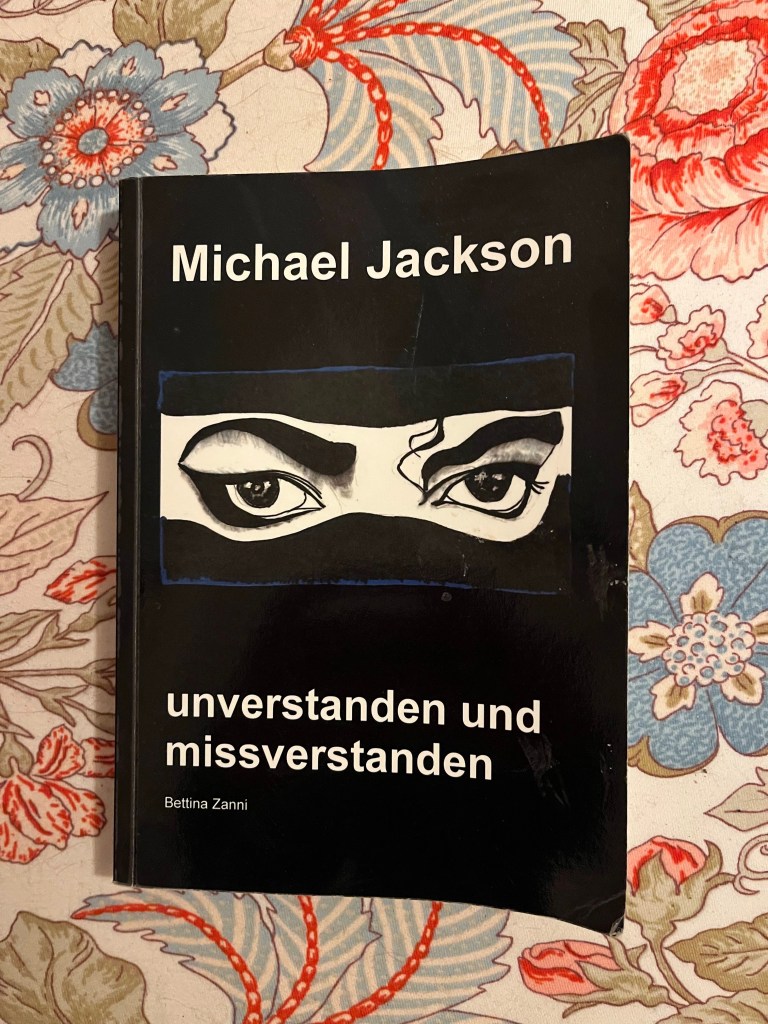
What began as admiration eventually became something closer to documentation: a way of holding together memory, media, and meaning. And yet, all fans are different. Some hold admiration uncritically, others dissect it. Many do both at once.
Can you be a fan and still analyse what you see from multiple angles? And perhaps more difficult still: can you ever truly separate the art from the artist?
Note to the reader: If there is one thing I take away from writing this piece, it is a renewed appreciation for journalism as a profession. At its best, it is not about choosing a side but instead about curiosity, asking difficult questions, and trying to understand the bigger picture. I came into this story wanting to explore a person (Bettina), not prove a point. Bettina’s journey reminded me that admiration and critical thinking do not always have to exist separately.
 Talks in Tan-dem
Leave a comment