
Welcome back, dear readers! I know it’s been a while since our previous profile. I’ve been busy living life to the fullest. But in the meantime, the world has remained full of wonderfully cool and interesting people, and I’m very excited to introduce you to the one who has caught my attention for our next spotlight: Pedro.
Pedro and I both started our PhDs in 2018, although we took two very different paths getting there. We also left the department in the same month last year and, once again, headed off in two very different directions. But perhaps “different directions” is not quite the right way to put it. Because while our paths may have looked very different on the surface, they shared something fundamental (other than the neuroscience): both were shaped by a curiosity about the world and a desire to understand it, albeit through very different lenses.
And this brings me to one of the most fascinating things about Pedro: his life sits at the intersection of two worlds we so often think of as separate: art and science. Often considered as opposites, science deals in evidence, precision and the pursuit of understanding, while art in imagination, expression and the freedom to see things differently. One seeks to explain the world, while the other seeks to interpret it. Somewhere along the way, we decided they belonged on opposite sides of the divide.
Pedro, however, embodies the contradiction to that idea. His life has been shaped by both art and science, and I can’t wait to share how. To quote good old Leonardo da Vinci, “To develop a complete mind: Study the science of art; study the art of science. Learn how to see. Realize that everything connects to everything else.”
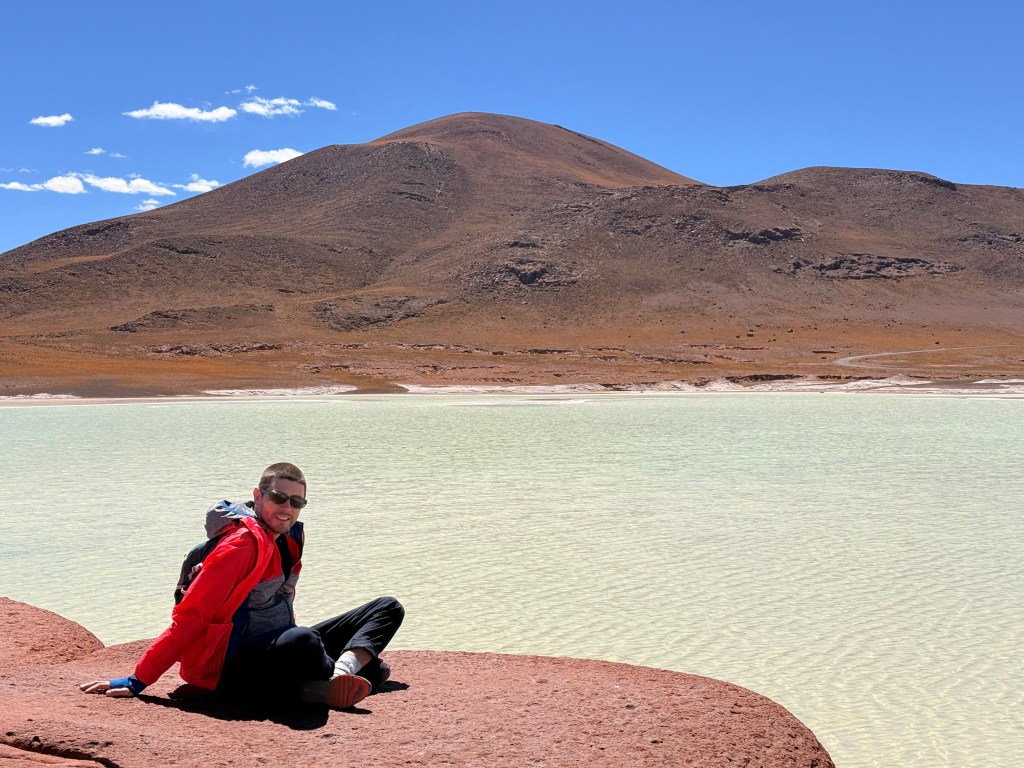
Let’s rewind…
To when Pedro was around 12 years old. He discovered a guitar in the basement of his parents’ house that belonged to his father, who had always dreamed of learning to play but never had the chance. Pedro decided to give it a go himself. He started taking classical guitar classes, before deciding, in a very teenage move, that classical simply wasn’t cool enough and switching to the electric guitar. He also joined his local church choir with friends.
But science was already competing for his attention. Growing up in the Chilean countryside, near the Andes, Pedro was fascinated by the natural world around him. His backyard became his first laboratory: he kept spiders as pets, explored with a magnifying glass, and religiously used a small microscope his father had given him. He even recruited his sister for backyard expeditions he organised.
By the age of 17, Pedro found himself at his first real crossroads. Music had become more than a hobby, and he was seriously considering applying to a music conservatory. His parents however, advised him to pursue science as a career with stability and opportunity, whilst keeping music as something he could continue alongside it. And so, with his future in mind, Pedro chose to pursue science.
His path eventually led him from an initial interest in dentistry to pharmacy, where he particularly enjoyed working with patients. But towards the end of his Master’s, an optional course on the neurobiology of addiction sparked something new. He became intrigued by fundamental research and, once again, found himself choosing a different direction; this time towards neurochemistry and neuroscience.
When it came time to choose a PhD, his professor told him to make a list of places he would like to go. The US, Paris, and Geneva, where one leading researcher in addiction neuroscience* worked. As luck would have it, his professor also knew a former student of this BNOC**: Camilla Bellone, who had recently started her own lab at the University of Geneva. Pedro was put in touch with her, secured a scholarship, and soon found himself on his way to Geneva. Science won the first round. But what happened to the guitar?
* the study of how drugs and compulsive behaviors change brain structure and chemistry
**BNOC: big name on campus (a term I picked up from my days in Durham)
The return of the guitar
Back in Chile, he had always kept his guitar and amplifier close by, but knowing he would be away for at least four or five years, he made the difficult decision to sell them before leaving. He arrived in Geneva with little more than the music in his head. It was quite a leap: a new country, a new continent, a new language, and a PhD to navigate. But somewhere along the way, Pedro knew he wanted to find his way back to music.
About a year into his PhD, his friends in the department gave him a voucher for a music store. I think I may have contributed to this gift as well – or so I tell myself, to let myself feel like I played a small part in his epic comeback. He used it to buy an acoustic guitar, and just like that, music found its way back into his life. Mirroring his childhood, an electric guitar followed not long after.
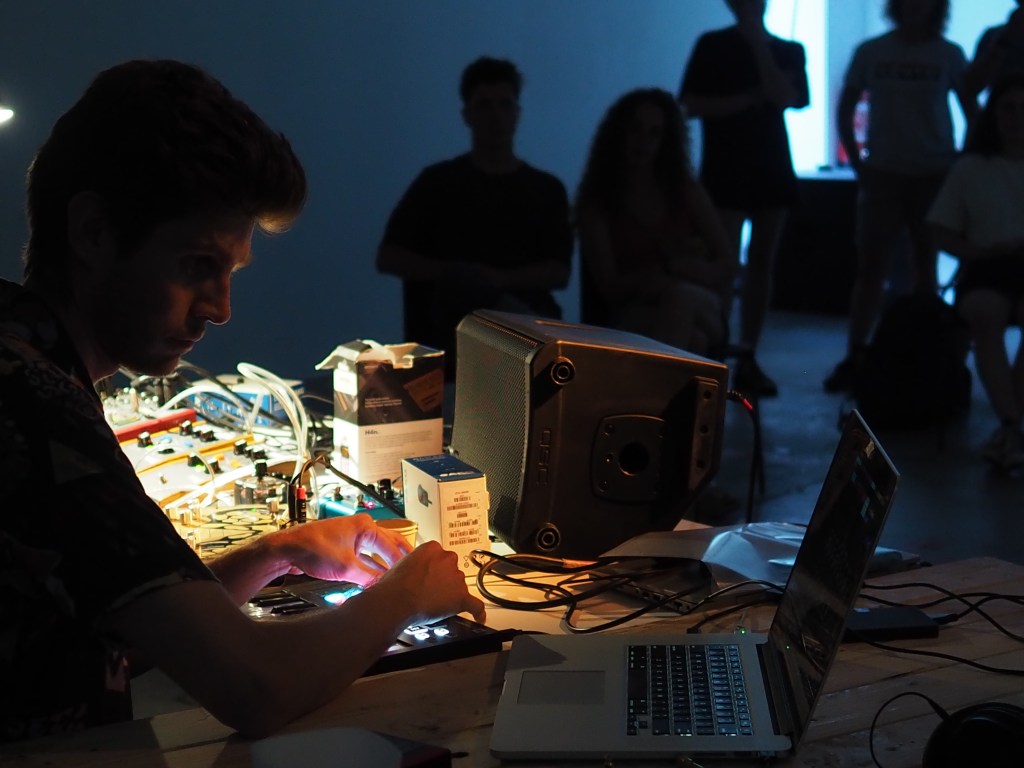
Pedro thus began looking for ways to bring his artistic side into the world around him, eventually joining INFOLIPO, a University of Geneva artistic association dedicated to creative projects. Through them, he took part in events such as the Festival Histoire et Cité and even presented experimental music at an exhibition exploring the relationship between science and art. But this was just the beginning. Over the years that followed, Pedro found more and more ways to weave his artistic and scientific interests together. Perhaps the best way to understand this fascinating intersection is to see it in action, through some of the projects where these two worlds have come together.
Nexus: When neurons make music
One of Pedro’s first experiments (outside of the lab) began with something he was already very familiar with: electrophysiological recordings. In simple terms, these experiments involve placing a tiny electrode near or inside a neuron to measure its electrical activity. But Pedro was intrigued by the fact that the equipment was doing more than recording data – it was also producing sound. During a technique known as blind patching, researchers can use an amplifier’s audio output to guide the electrode: as it moves through the tissue, changes in electrical resistance alter the pitch, with the sounds shifting as the electrode approaches a cell membrane.
Pedro began recording these sounds and realised he could turn them into more. The result was N-Plexus, an experimental piece of music built almost entirely from the raw sounds of a real electrophysiology experiment. For the accompanying event, he even brought along an actual pipette, using it to explain the science behind the sounds while simultaneously presenting the artistic work. It was his first real foray into science-art, and also the moment he started to question whether the boundary between the two was really necessary at all.
Analoger Widerstand: Making surveillance visible
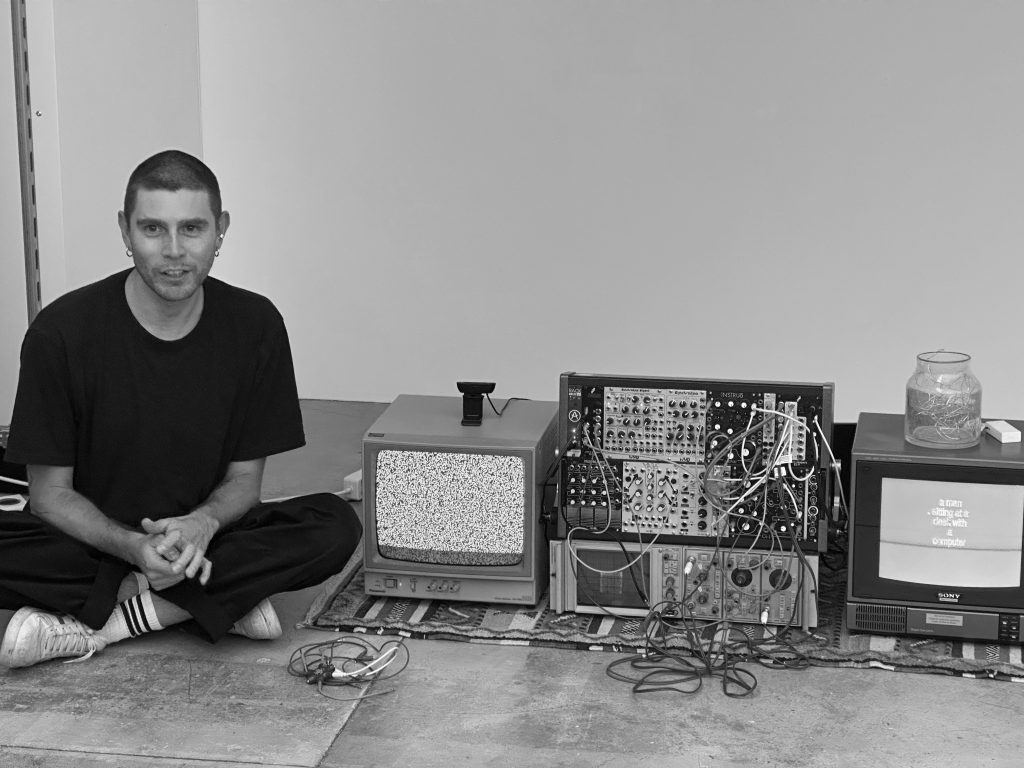
Pedro’s next project took his experiments in sound and technology in a rather different direction. Analog Resistance (in English) is an installation exploring surveillance, and uses technology that feels almost like a relic from another era: a vintage analog oscilloscope. An oscilloscope is a laboratory instrument that turns electrical signals into visual patterns on a screen, allowing you to see electricity in action. In Pedro’s installation, live feeds from publicly accessible surveillance cameras are transformed into these electrical signals, producing constantly shifting patterns on the oscilloscope. A separate machine-learning system interprets what the unseen camera is “seeing” and displays its captions on an old CRT monitor – the bulky, box-shaped screens many of us remember from before flat screens took over.
The result is a strange reversal of surveillance: the audience never sees the original images, but instead witnesses the data and interpretations generated from them. Even the visitors become part of the system, with a camera tracking their presence and feeding it back into the installation. Yet there is a deliberate twist: because the work relies on offline analog hardware, these signals cannot be digitally stored or tracked. Surveillance is transformed into something physical, visible and fleeting: electricity, light and sound. Once again, Pedro takes a scientific technology and turns it into a way of asking us to look at that technology differently.
Gesture-Controlled Soundscapes: Turning one musician’s movement to another’s music
What if the movement of one musician could control the sound of another? I guess that was the question Pedro asked himself before he started another intriguing project Gesture-Controlled Soundscapes. During a workshop with Ensemble Contrechamps, Pedro built a small device using an Arduino (a tiny programmable computer of sorts that can receive information from sensors) and an accelerometer (a sensor that detects movement) and attached it to the arm of a cellist. As the cellist moved while playing, those movements were translated into real-time changes in the sound of a clarinet player.
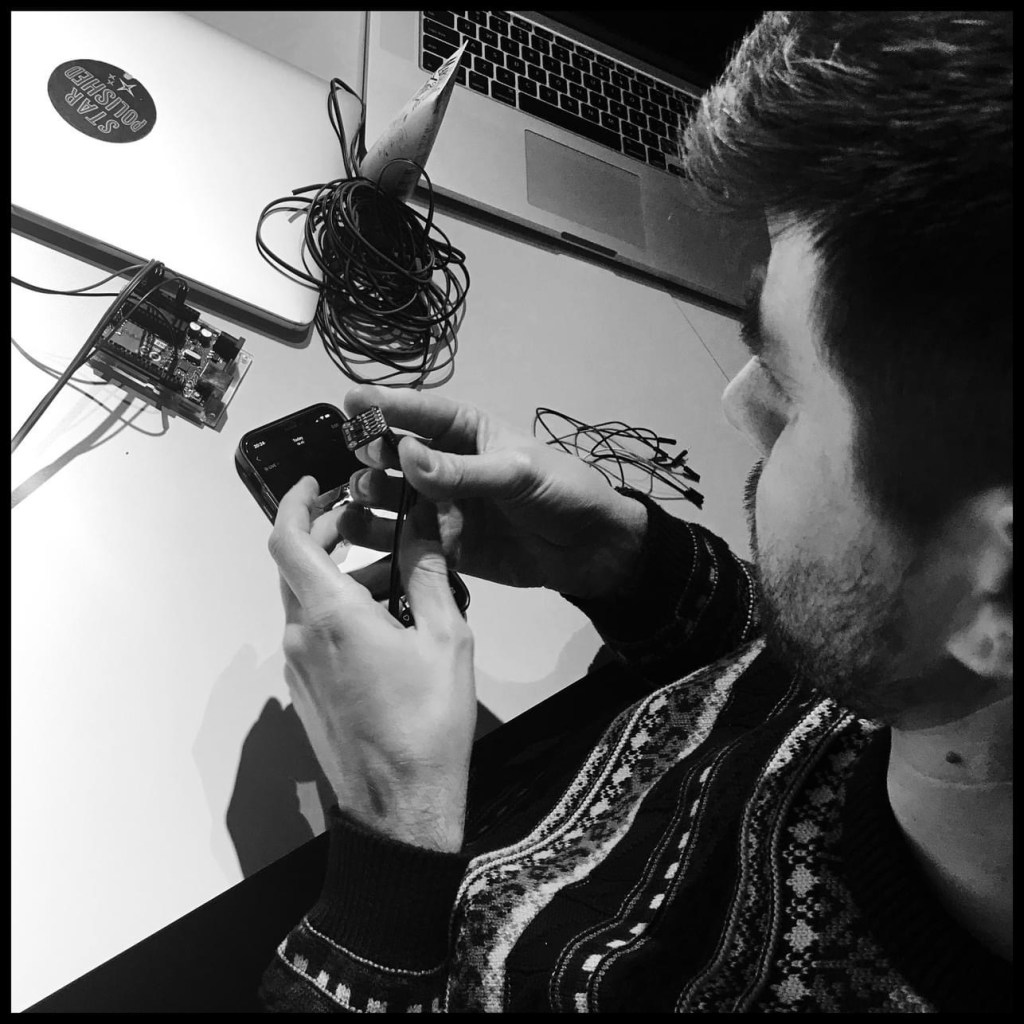
Developed over just a few days and eventually performed live, the system turned the cellist’s physical gestures into another kind of instrument, creating an unexpected musical conversation between the two performers. Once again, Pedro found a way to use technology to transform it into a new form of artistic expression.
The science of repetition
By now, Pedro has experimented with many different combinations of art, science and technology, including several other fascinating projects that I haven’t had the chance to describe here, including a Super 8 film festival submission. But one of his most interesting projects is unfolding as you read.
Together with a classical music composer, Pedro is working on a research project exploring how our brains respond to repetition in music. When does a repeated sound become boring, and when does it become interesting? How much familiarity do we need before we crave novelty? And when does repetition become so engaging that it can induce something resembling a trance?
To explore these questions, Pedro has been conducting interviews across neuroscience labs, including his old PhD lab. He is looking at everything from how animals perceive time and tempo to the neural circuits that allow some birds to process these patterns, asking questions about when these abilities might have emerged in the brain. He is also exploring memory and prediction, including how our own knowledge influences the way we listen: someone with a background in music theory, for example, may be better able to predict what comes next in a melody.
Ultimately, the project aims to take these neuroscientific concepts and use them as a lens through which to understand music. Even minimalist music, a style that emerged in the 1960s and relies heavily on simple, repeating patterns, offers a playground for these questions. And perhaps most interestingly, the project has forced Pedro to step outside the traditional scientific mindset – something he admits has not always been easy for a scientist. We do, after all, tend to give an awful lot of importance to data (guilty as charged).
You don’t have to choose
It seems as though Pedro never really stopped looking for ways to bring his different interests together. Today, he has not one but two jobs, allowing him to do so. At Unisanté, he works on research into gender bias in medicine in Switzerland, while at the Haute école de musique de Genève, he works as an adjoint scientifique (a sort of scientific collaborator) on a project exploring the physical and mental health of musicians. Add to that his ongoing research project on repetition, and Pedro has truly found a way to build a career around his different curiosities, rather than choosing just one.
And when he is not doing any of that (just like me, you are probably counting the number of hours in a day), you might find him at his atelier (workshop in French), which he shares with another musician. Here, he is able to create music in its purest form – he plays, improvises, experiments and records his own compositions, moving between electronic music, jazz and Brazilian bossa nova. Perhaps most importantly, he doesn’t feel the need to intellectualise it in this space. I guess not everything has to be an experiment or a research question.
Pedro has not yet released his music, but if he ever does, it will be under a pseudonym. He has already chosen one, inspired by an unfortunate typo in a job rejection email that addressed him as “Dear Padro”. We have all had an embarrassing email moment at some point. So, when life gives you lemons… you might as well turn them into a stage name.


Leave a Reply